How to make live sports advertising work for local markets
Key takeaways
- Local and multi-location advertisers can target live sports on CTV by DMA and ZIP code, even though no platform can guarantee a specific game, programmatic CTV reaches relevant sports audiences in the exact markets where a business operates.
- The 70/30 Blueprint turns one broadcast into a full-game strategy—about 70% of the budget goes to premium CTV and live sports inventory to create the high-attention moment, and the remaining 30% extends across online video, mobile, desktop and display to stay with fans as they move between screens.
- Live sports advertising should be measured by business outcomes, not just impressions. Connecting CTV exposure to calls, leads, appointments, visits and sales holds sports spend to the same accountability as search and social.
Live sports commands attention at a scale few media environments can match.
In 2025, sports accounted for 96 of the 100 most-watched U.S. telecasts, tying an all-time record. Football alone represented 92 of them, including a record eight college football games in the top 100.
That concentration of attention is why advertisers want in - and why premium sports inventory can command premium prices.
The economics at the very top make the point. NBCUniversal sold out Super Bowl LX months before kickoff and had already sold 90% of its remaining NFL inventory before the 2025 season began. The record cost of a 30-second Super Bowl LX ad exceeded $10 million.
But live sports advertising is much bigger than the Super Bowl, the World Series or one NFL game.
College football, college basketball, the NBA, NHL, MLB, soccer, golf, women's sports and other live events create high-attention opportunities week after week. And streaming is giving advertisers more ways to participate through programmatic, private-marketplace, programmatic-guaranteed and other buying paths.
For local and multi-location advertisers, that creates a different question: How do you turn the attention around live sports into something relevant—and measurable—in the markets where you actually do business?
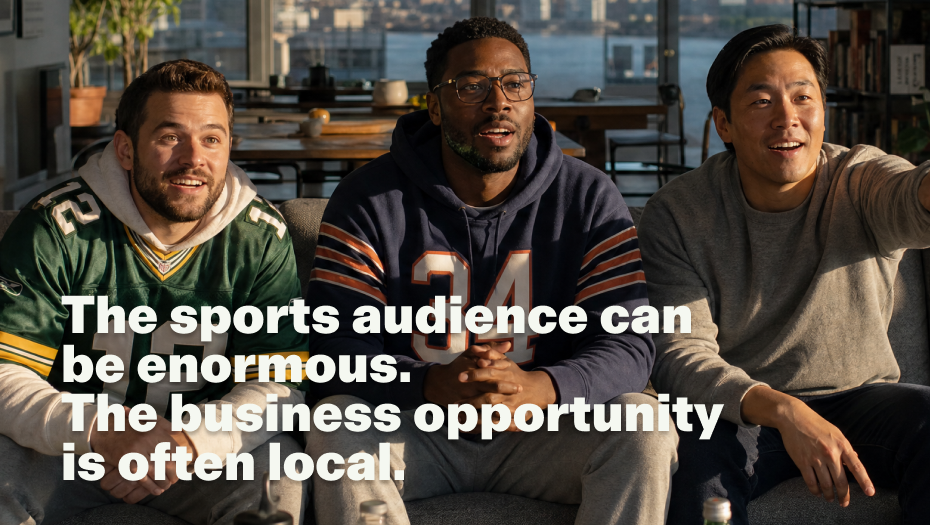
The sports audience can be enormous. The business opportunity is often local.
A dealership group in Austin may want to benefit from the attention surrounding college football. Its real opportunity, however, is reaching relevant fans in Austin and the surrounding markets where it has dealerships.
A personal injury firm does not need every basketball viewer in America. It needs visibility among relevant sports audiences in the communities where it practices.
A restaurant group, franchise system or regional retailer has the same challenge: connect premium sports attention to the locations where customers can actually visit, call, book or buy.
That is one of the biggest opportunities streaming brings to sports advertising.
Instead of treating a large national audience as the objective, advertisers can use geography, audience, timing and available inventory to make the sports moment relevant to a specific market.
What live sports inventory can advertisers access?
There are multiple ways into live sports. The right one depends on what the advertiser is trying to accomplish.
A buyer may access sports through:
- Standard programmatic live sports inventory
- Private marketplace deals
- Programmatic-guaranteed inventory
- Publisher or network direct deals
- Linear television
- League, sport or season-based packages
- Broader sports audience and contextual inventory
The tradeoffs are different.
A standard programmatic campaign can provide flexibility and efficient access to available live sports inventory, but it generally does not guarantee one specific game or commercial break.
If a particular event is mandatory, a programmatic-guaranteed, direct or upfront path may provide firmer inventory commitments—but typically with greater lead time, higher minimums and different economics.
That is why the better question is not simply: "Can I buy live sports?"
In many cases, the answer is yes.
The better questions are:
- What level of specificity do I actually need?
- What inventory is available for that need?
- And what is the smartest use of my budget?
The market itself is moving in this direction. New programmatic live-event buying tools are making it easier to filter inventory by factors such as league and daypart, manage pacing and access premium sports without relying solely on traditional upfront buying.
How much does live sports advertising cost?
There is no universal live sports CPM.
Pricing changes based on:
- Sport and league
- Publisher or network
- Market
- Event or game
- Level of guarantee
- Audience
- Geography
- Timing
- Supply and demand
At one end of the spectrum are national tentpoles where placements can cost millions and inventory sells out months ahead.
At the other are programmatic sport, league and market-based campaigns that allow regional advertisers to participate at a very different investment level.
The important planning principle is: The more specific the request, the more the economics can change.
"Reach college football viewers in the Austin DMA over a month" gives a buyer more flexibility and potential scale than "put me in one Texas game on one network in five ZIP codes."
Neither request is inherently wrong. They are simply different media buys.
If a particular game is essential, ask what guaranteed buying options exist and what they cost.
If the objective is to reach relevant sports audiences in a market and drive business outcomes, a broader programmatic strategy may provide more flexibility.
Streaming is changing how fans experience sports
Live sports is no longer one screen, one feed or one viewing behavior.
Nielsen's Tops of Sports: Media trends shaping sports marketing for 2026 highlights the increasing importance of multi-platform sports viewing. Nielsen found that linear and streaming can attract different, complementary audiences around live events and recommends multi-platform strategies to maximize reach and audience depth.
Fans also move between screens throughout the game.
They check scores and statistics. Follow fantasy teams. Read sports coverage. Message friends. Watch another game. Look up a player. Follow what is happening elsewhere in the league.
That creates an opportunity for advertisers to think beyond the commercial break.
Even when you are in the game, the game is not the entire sports experience.
Plan the sports moment - not just the placement
A useful way to think about live sports is to treat the broadcast as the anchor of a larger high-attention window.
Start with the premium video opportunity.
Then ask what should happen around it.
For example, a local advertiser could:
- Activate available college football inventory in the Austin market.
- Focus the plan on the audiences and geography most relevant to the business.
- Extend visibility during priority game windows across online video, mobile, desktop and other sports-related digital environments.
- Measure whether the campaign contributed to calls, leads, appointments, visits or sales.
The goal is not to replace live sports inventory.
It is to make the live sports investment work harder.
The 70/30 Blueprint for live sports
One way to structure the plan is through a 70/30 framework.
The percentages can flex based on inventory, objective and budget. The important part is assigning each part of the plan a job.
The 70: create the moment
Put the majority of the investment into premium CTV and live sports environments that provide:
- Sight, sound and motion
- High-attention video
- Reach
- Brand impact
- Demand creation
The 30: extend the moment
Use complementary digital channels to extend reach and reinforce the message through:
- Online video
- Mobile
- Desktop
- Display
- Other relevant digital environments
Run separately, these can look like unrelated media line items.
Planned together, the 30 makes the 70 work harder by keeping the advertiser visible as fans move between screens and adding opportunities to reach the audience throughout the broadcast window.
That is especially valuable when premium in-game inventory is scarce, expensive or limited in scale.
Example: make college football locally relevant
Consider a personal injury firm serving the Austin market.
The advertiser wants to benefit from the attention around University of Texas football.
A practical campaign could be built around:
- Market: Austin DMA
- Audience: College football and relevant sports audiences
- Live sports: Available college football inventory
- Timing: Priority games and broadcast windows throughout the season
- Cross-screen extension: Online video, mobile, desktop and sports-focused digital environments
- Measurement: Calls, leads, appointments and other supported business outcomes
If a particular matchup is essential, the advertiser can also explore the availability and economics of guaranteed inventory.
But the broader plan does not have to depend entirely on one commercial break in one game.
That is the difference between buying a placement and building a sports strategy.
Live sports should be accountable to business outcomes
Reach, impressions and completion rates remain useful media metrics.
But they are not the end of the story.
If CTV is going to compete for performance budgets, advertisers increasingly need to understand what happened after the exposure.
Depending on the business and measurement setup, that can include:
- Calls
- Leads
- Appointments
- Website activity
- Store or dealership visits
- Online purchases
- Offline sales
The industry is moving in the same direction. Recent commentary around the 2026 World Cup describes it as a test of whether programmatic live sports can prove its economics when premium CPMs meet performance-oriented budgets and omnichannel alternatives.
The implication for advertisers is straightforward: Decide what business outcome matters before building the sports plan - not after the campaign ends.
Before you buy live sports, ask these five questions
1. What exactly is included?
Are you buying live games, broader sports programming, league inventory, contextual environments or audience targeting?
The distinction matters.
2. What is guaranteed?
Understand which inventory is committed and which delivery depends on available programmatic supply.
If a particular game or event is critical, ask about programmatic-guaranteed or direct options.
3. How local can the campaign get without losing meaningful scale?
More precision is not automatically better.
Start with the business footprint, then determine how narrowly the available inventory can be targeted while still delivering enough reach.
4. What should happen around the live broadcast to extend reach and frequency?
The commercial break is one part of the sports experience.
Consider how online video, mobile, desktop and other channels can reinforce the message as fans move between screens.
5. How will success be measured beyond impressions and completion rates?
Know before launch whether the campaign can be connected to calls, leads, appointments, visits, sales or other meaningful business outcomes.
Those five answers will tell you far more about the quality of a live sports plan than a page full of league logos.
How Jamloop approaches live sports
At Jamloop, our approach is built around a simple idea: In the game where inventory allows. Around the game everywhere else.
Jamloop activates available live sports inventory across priority markets and uses Jamloop Sports Surround™ to extend the campaign across eligible household screens during the broadcast window.
Sports Surround is not a replacement for live sports inventory. It is the reach-and-frequency extension of the strategy - designed around the reality that fans move between screens throughout the game.
It is also an application of the 70/30 Blueprint: use premium CTV and live sports to create the high-attention moment, then use complementary digital media to extend it.
And measure the result against what matters to the business - from calls and appointments to visits and sales.
Live sports does not have to be an all-or-nothing choice between buying the biggest game in America and sitting on the sidelines.
There are more ways into the market than ever.
The job is to choose the right combination of inventory, geography, audience, timing, cross-screen reach and measurement for the business you are trying to grow.
The game creates the moment. The media plan determines what you do with it.
FAQ
Can local businesses advertise during live sports on CTV?
Yes. Programmatic CTV can allow advertisers to target live sports inventory geographically by DMA and, depending on available scale, more granular local footprints.
Can CTV advertisers guarantee a specific live game?
Standard programmatic buying generally does not guarantee a particular team or game. Programmatic-guaranteed inventory may be available for some events with sufficient lead time, budget and publisher approval.
What is cross-screen live sports advertising?
It extends a live sports campaign beyond the television into complementary mobile, desktop, online video or display environments during the broadcast window.
How do you measure live sports CTV advertising?
Beyond impressions and completion rates, advertisers can connect CTV exposure to outcomes such as calls, leads, appointments, visits and sales when the appropriate attribution data is available.